
Tendências de Seladores a Vácuo 2026: O que as marcas de armazenamento de alimentos precisam saber
Compartilhe:
-

-

-

-


Copiado
Compartilhe:
-
-
-
-
Copiado
Bombas de vácuo com potência nominal de -80 kPa podem deixar ar ao redor de superfícies alimentares irregulares e produzir vedações fracas após múltiplos ciclos. A bomba pode atender à especificação, but the finished package still fails due to moisture contamination, inadequate heat transfer, or inappropriate bag materials.
For food storage brands developing products in 2026, the purchasing question is focusing on the consistency of a machine in generating acceptable packages rather than how much vacuum a machine generates.
Na YUMYTH, we have identified 6 main considerations in engineering that determine the selection of a vacuum sealer. These are, evacuation control, Manuseio de umidade, Confiabilidade do selo, Preparação da Bolsa, packaging materials and application qualification.
1. Vacuum Pressure Alone Does Not Determine Packaging Performance
Two machines with the same maximum vacuum rating may deliver different package times.
An external-suction sealer draws air through embossed channels in the bag. As the film collapses around the contents, the embossed channels become the main evacuation channels. Restrictions in the channel caused by the placement of food, narrow channels, or a gasket leak can reduce effective airflow.
Pump displacement and achievable vacuum are two different performance characteristics.
O YUMYTH VS6121 Vacuum Sealer offers an 8 L/min pump, and 120 W rated power, and -80 kPa vacuum pressure. Evacuation speed is dependent on several factors, including the size of the package to be evacuated.
Brands should test the machine with different food, Tamanho da bolsa, and thickness and evaluate cycle time, visible residual air, and vacuum consistency. Pump performance should be evaluated using realistic obstructions to evacuation, as opposed to nominal performance claims.
Na prática, falando, higher vacuum specifications provide limited value to the purchaser without information on package performance.
2. Moisture Control Is Becoming a Critical Design Requirement
Vacuum packaging becomes less predictable when food contains surface moisture, Marinadas, ou líquido livre.
Quando o ar sai da bolsa, pressure differences can pull liquid toward the evacuation channel. If moisture reaches the heating strip, it may interrupt contact between the sealing layers. The resulting weak areas can become leakage paths during refrigeration or handling.
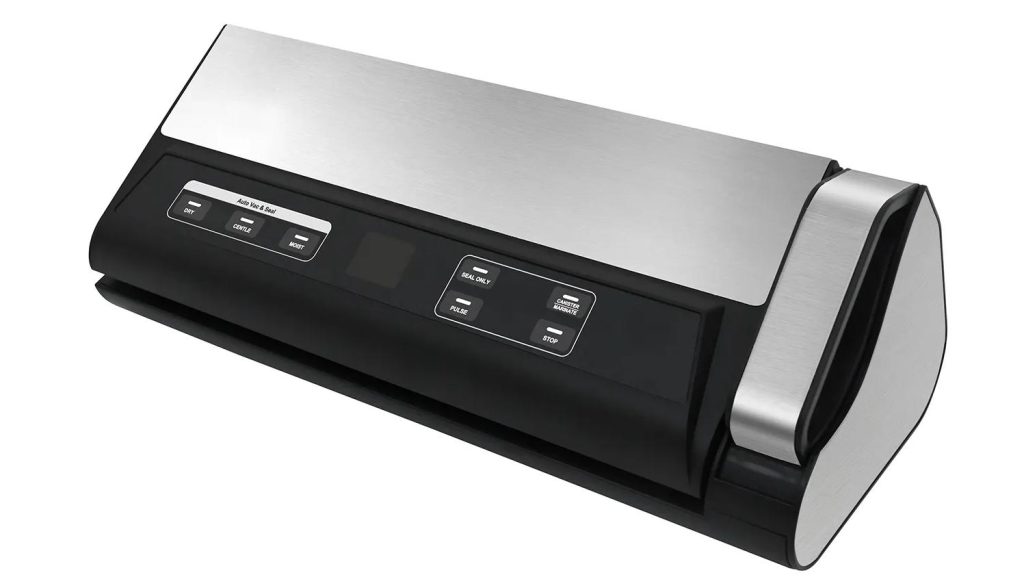
The VS6121 provides Dry, Úmido, Gentil, Pulso, and Seal Only operating modes. Pulse control allows users to stop evacuation before delicate contents are compressed or liquid approaches the bag opening.
These functions expand application flexibility, but they do not make an external-suction machine suitable for unrestricted liquid packaging.
Para sopas, molhos, and other products containing substantial free liquid, a chamber sealer may be more appropriate. Its pressure-balanced evacuation process reduces the tendency for liquid to be drawn directly through a suction channel, although foaming and boiling under reduced pressure can still occur.
Chilled meat, damp vegetables, and soft bakery products have different operational limitations, and are thus, validated separately by the OEM. When evaluating a different mode, Migração líquida, Deformação do produto, and the integrity of the seals, should take precedence compared to the available modes by their names.
3. Double Heat Sealing Addresesses One Failure Mode, Not Every Leak
A variety of factors impact the quality of the heat seal. Not adjusting the temperature and time sufficiently can lead to an inadequate heat seal. Adjusting the temperature and time beyond what is necessary can also negatively impact the seal.
Wrinkles and grease on the surface of the product can lead to an inadequate seal. Liquid contamination can cause failure modes to occur.
O VS6121 utiliza duas linhas de vedação independentes de 3 mm. This provides an additional closure barrier compared with a single line, but both seals can fail if they experience the same contamination or heating problem.
A meaningful comparison should include seal-strength testing, such as ASTM F88/F88M-23, together with appropriate leak-detection methods.
Testing should cover repeated cycles, different approved bag materials, and packages exposed to refrigeration or freeze-thaw conditions.
Consider thermal recovery. With repeated sealing, the heater and adjacent parts may not reach the same thermal equilibrium state from cycle to cycle. Portanto, manufacturers should test whether the consistency of the seals changes in accordance with the intended operating duty cycle.
Being able to double seal can be advantageous; no entanto, measured package integrity, not the line count, determines a technique's value.
4. Integrated Roll Storage Modifies Film Use and Usability
Pre-cut bags allow for simple use, but provide little flexibility. Bags that are too big waste film, and bags that are too small may not evacuate and seal properly.
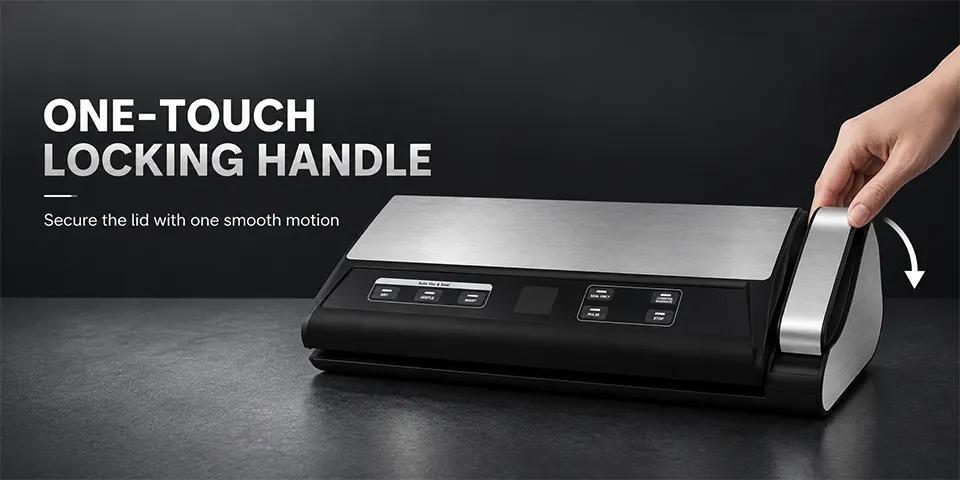
The VS6121 provides integrated roll storage and a slide cutter. It allows users to cut bags to the size they need. It has a maximum working width of 30 cm.
The material-saving potential depends on how users cut and seal the film. Each custom-made bag requires enough excess length for evacuation, Vedação, e manuseio. Repeated cutting errors can eliminate the expected savings.
Film structure introduces another constraint.
External-suction sealers normally require embossed bags to maintain air channels during evacuation. Smooth films may collapse against themselves and obstruct airflow before the desired vacuum is reached.
Para equipes de compras, acceptability to a vacuum should be evaluated with film thickness, Textura da superfície, heat-sealing characteristics and puncture resistance.
The right comparison is to the cost of the completed package.
5. Packaging Sustainability Is Increasing Material Validation Requirements
The EU Packaging and Packaging Waste Regulation (PPWR) started to apply on August 12, 2026, with other requirements to follow at their respective times.
For brands sourcing vacuum packaging materials to supply to the European markets, regulatory assessments need to distinguish between the packaging and the electrical sealing equipment.
Traditional PA/PE multilayer films are composed of layers to provide a combination of mechanical and barrier performance with heat-sealability. Using different material structures can change the characteristics of the package such as puncture resistance, seal temperature, and cooling behavior.
Sealing parameters may also affect the geometry of the package.
Alternative vacuum bags should be assessed to meet:
•The food contact requirements of the target market
•Oxygen and moisture barrier performance
•Seal strength and leakage performance
•Material and end-of-life considerations
In the case of a material change, the vacuum packaging bag should be assessed to meet the required barrier and mechanical performance of the package.
6. OEM Buyers Need Application-Based Acceptance Criteria
For brands of food storage equipment, applicances which integrate electrical and mechanical packaging requirements, a vacuum sealer should integrate electrical, mechanical and packaging requirements.
YUMYTH also offers OEM/ODM services, including product development, Prototipagem, Personalização, and manufacturing.
We recommend determining measurable acceptance criteria for evacuation time, Resistência do selo, Vazamento, repeated-cycle performance, cutter durability, e compatibilidade de acessórios, prior to approval for production.
The VS6121 also allows for the use of external vacuum accessories, such as compatible canisters and wine stoppers. The fit and retention of the vacuum of the accessories should be tested separately from the performance of the heat sealed bags.
Published product specifications are generally used as a reference. The final determination is made using sample units and agreed upon test conditions.
Brands in the process of sourcing or developing a vacuum sealer for 2026 may review the YUMYTH VS6121, ou contato com a YUMYTH, to discuss their application requirements and possible OEM options.
Perguntas frequentes
Q1: What are the key Vacuum Sealer trends in 2026?
The main trends include controlled evacuation, reliable double heat sealing, Manuseio de umidade, custom-length bags, alternative packaging materials, and application-based OEM testing.
Q2: What vacuum performance does the YUMYTH VS6121 offer?
The VS6121 specifies -80 kPa vacuum pressure and an 8 L/min pump. Actual evacuation time depends on bag dimensions, food geometry, and airflow resistance.
Q3: How does YUMYTH's double heat-seal system work?
O VS6121 utiliza duas linhas de vedação independentes de 3 mm. They provide an additional closure barrier, but seal reliability still depends on temperature, Pressão, and bag material.
Q4: Can the YUMYTH VS6121 seal moist or delicate foods?
Sim. Seco, Úmido, Gentil, and Pulse modes support different food conditions. Pulse control helps limit compression and liquid movement during evacuation.
Q5: Is the YUMYTH VS6121 suitable for vacuum sealing liquids?
It is an external-suction machine, not a chamber sealer. Foods containing substantial free liquid may require chamber equipment to reduce liquid migration.
Artigos Relacionados
Como funciona uma máquina de slush sem gelo?
2026-10-29
POR U arafatshuvo509
O uso tradicional de gelo picado no liquidificador para misturar um ingrediente em um tecido espesso, A bebida gelada foi substituída pelos fabricantes de slush de hoje, que conseguem alcançar o mesmo resultado usando ...
Máquina de Raspado Compressor: Sistema de Resfriamento e Tecnologia de Mistura
2026-10-29
POR U arafatshuvo509
Uma máquina de raspagem compressora utiliza um processo de refrigeração integral com agitação mecânica contínua do líquido refrigerado para produzir semicongelado (Slushy) líquidos criando cristais de gelo diretamente a partir do líquido. ...
Máquina de gelo para cozinha pequena: Design Compacto para Moradia em Apartamento
2026-10-27
POR U YUMYTH
Uma máquina de gelo que se encaixa em uma bancada de apartamento ainda pode ser difícil de operar. Uma parede pode obstruir o fluxo de ar do condensador, Um armário superior pode impedir que a tampa abra....
Tendências de Máquinas de Gelo Independentes 2026: Gelo Claro, R290, e Controles Inteligentes
2026-10-27
POR U YUMYTH
Uma máquina de gelo independente que pode produzir 12,6 kg de gelo em um dia pode ainda não atender às expectativas. Seu gelo pode ficar nublado devido a ciclos curtos de congelamento, É ...